
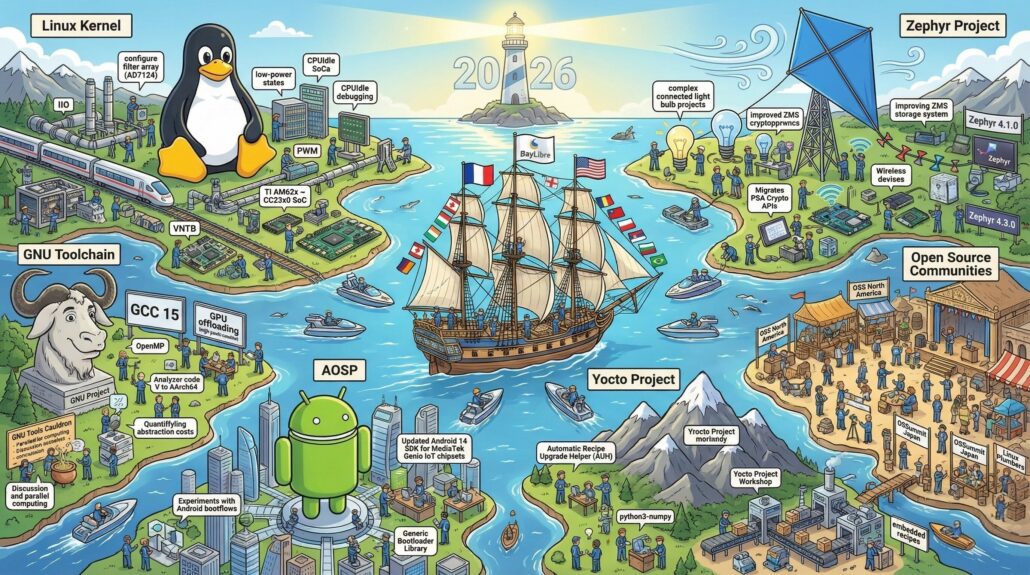
As we enter 2026, it is a perfect opportunity to look back at 2025 and how we have been involved with and contributed to different open-source ecosystems and communities.
Over the past year, BayLibre has acted as an active contributor and maintainer within projects including the Linux kernel, Zephyr RTOS, the Yocto Project, the GNU Toolchain, Mbed-TLS, U-Boot, AOSP and many others.
While the highlights below capture some key milestones, they are not an exhaustive list of every achievement, as many daily contributions and maintenance tasks are not included.
We want to give kudos to the entire team making this happen, from those upstreaming daily patches to our official maintainers and conference speakers. Our involvement in these communities is a continuous journey intended to exchange ideas, contribute to the wider ecosystem, and help bring products to life with upstream software.
January – March: Bootflows and Subsystem maintenance
We began the year with technical experiments on Android bootflows, exploring U-Boot’s standard boot and the Generic Bootloader Library (GBL) on the BeaglePlay board.
In the Linux kernel, we were ranked among the top 20 contributing companies for the v6.13 release. Our work focused on the IIO and PWM subsystems, as well as introducing support for multiple system-wide low-power states for TI AM62x SoCs.
By March, we contributed to the Zephyr 4.1.0 release, specifically through optimizations to the ZMS storage subsystem and expanded support for the TI CC23x0 SoC family, and again to the Linux kernel v6.14 release (contributions to PM Domains, IIO, PWM, Kernel Infrastructure, IRQ Chip Support and misc).
April – June: Technical Case Studies and Community Events
In April, we shared our expertise in Yocto Project maintenance through a case study on the python3-numpy recipe and a guide on using the Automatic Recipe Upgrade Helper (AUH for build automation.
Our team also participated in the RISC-V Summit Europe, presenting a Compared Analysis of GCC Codegen for AArch64 and RISC-V and a Python Packaging Infrastructure for the RISCV64 Ecosystem.
May was a productive month as we served as the official organizer for Embedded Recipes 2025 in Nice. Among all the high quality talks, the event featured a technical talk on Zephyr’s cryptographic features from BayLibre and dedicated Yocto Project, labgrid, libcamera and Pipewire workshops.
During this quarter, we also delivered an updated Android 14 SDK for MediaTek Genio IoT chipsets, contributed to the Linux kernel v6.15 release (IIO, PWM, Kernel, Clock, GPIO and SPI Offloading infratructures, MediaTek and TI platforms support and other) and introduced the new SPI offloading framework for the Linux kernel during OSS North America.
July – September: Toolchains and the European Tour
The summer was highlighted by the releases of:
- GCC 15, where our compiler team contributed 395 commits focusing on OpenMP and GPU offloading for high-performance computing and supercomputers. This work is vital for achieving computational capabilities within a sustainable power envelope.
- The Linux kernel v6.16, where the team continued its work on IIO, PWM and SPI Offload, contributed as well to the VT/Console, RTC, Clock subsystems and provided support for ARM/OMAP and Mediatek platforms.
- Zephyr 4.2.0 , with contributions on new hardware platform support, Kernel optimizations, Storage subsystem improvements, Power Management and Cryptography / Security enhancements.
In August, eight team members attended OSS Europe in Amsterdam delivering six technical talks:
- Why Won’t My CPU Sleep? Debugging cpuidle Mysteries on ARM SoCs (Embedded Linux Conference)
- Do It Faster: How We Supercharged Linux to Work with Blazing Fast ADCs for IIO (Embedded Linux Conference)
- Powering Up Lab Automation with labgrid and CI (Embedded Linux Conference)
- Cryptography Support in Zephyr: Recent Changes and Upcomings (Zephyr Developer Summit)
- Running Zephyr in a Light Bulb (Zephyr Developer Summit)
- ZMS: a New Lightweight Storage System (Zephyr Developer Summit)
In September, we sponsored the GNU Tools Cauldron in Porto, where our engineers presented and led discussions on:
- Comparative Analysis of GCC Codegen for AArch64 and RISC-V
- Parallel Computing, Offloading, OpenMP and OpenACC
- Toolchain and Linux kernel
- Quantifying Abstraction Costs in GCC
- Reviewing refactoring goals and acceptable abstractions in GCC
We also participated in Kernel Recipes in Paris, focusing on the technical components and community of the GNU Compiler Collection.
The Linux kernel v6.17 was also released where we notably contributed across multiple subsystems, focusing on IIO drivers, PWM infrastructure, SPI offload support, and platform improvements. BayLibre was once again among the top 20 contributing companies and some top 10 individual contributors by number of changesets.
October – December: Global Collaboration and Year-End Releases
As the year concluded, we shared results on quantifying abstraction costs in GCC to identify compilation speed or memory consumption regressions.
In November, we hosted a community gathering at Embedded World North America to connect with partners and customers. We also contributed to the Zephyr 4.3.0 release, which included SoC-level power management and improved PSA Crypto API migration.
The year ended with our team traveling to Tokyo for OSSummit Japan and the Linux Plumbers Conference, where we presented on multiple system-wide low-power states.
We remained a significant contributor to the final kernel release of the year, Linux kernel v6.18, which included our work on IIO, PWM, Clock, and ARM subsystems, delivering improved ADC drivers, SPI offloading, and critical SoC support for Amlogic, TI, and Renesas platforms.
Looking Forward to 2026
Our journey continues into the new year as we maintain our efforts in the communities where we hold contribution and maintainership roles, still including Linux kernel, Zephyr RTOS, the Yocto Project, the GNU Toolchain, Mbed-TLS, U-Boot, AOSP and many others.
We are already preparing to host the next edition of Embedded Recipes in Nice on May 27-28, 2026 and our 2026 conference schedule is taking shape with confirmed speakers for several key events (and more to come):
- SCA/HPC Asia in Osaka
- FOSDEM in Brussels
- RISC-V Summit in Bologna
- OSS / ELC Europe and Linux Plumbers in Prague
- GNU Tools Cauldron
- IWOMP 2026 in Vienna
- SC26 (Supercomputing) in Chicago